


Am Phu Cave Da Nang: Travel Guide, Things to Do & How to Get There

Am Phu Cave is a masterpiece of natural wonder and human creativity that vividly re-creates the Buddhist interpretation of hell and heaven. Unlike any other cavern in Vietnam, this incredible destination takes you on a symbolic journey from earthly life through the courts of judgment and into the realms of penance and salvation. It’s part geological marvel, part spiritual lesson, and entirely captivating. For travelers seeking an experience beyond the typical beach or city tour, Am Phu Cave offers a profound and atmospheric adventure. In this comprehensive GTrip guide, we cover everything you need to know to explore this fascinating "Hell Cave".

An overview of Am Phu Cave in Da Nang City

Am Phu Cave, often referred to as the "Hell Cave", is the largest and most elaborate cave within the Marble Mountains scenic area. While the other caves in the complex are known for their serene Buddhist sanctuaries and natural beauty, Am Phu Cave stands apart for its dramatic and immersive theme.

Where is Am Phu Cave?

Location: 81 Huyen Tran Cong Chua Street, Ngu Hanh Son Ward, Da Nang City

Am Phu Cave is located at the base of Thuy Son (Water Mountain), the largest and most famous of the five karsts that make up the Marble Mountains. Situated conveniently between the city of Da Nang and the ancient town of Hoi An, it’s an easily accessible stop for most travelers exploring the region. The entrance is near Gate 2 of the Marble Mountains complex.

Am Phu Cave sits at the base of Thuy Son (Water Mountain) in the Marble Mountains, conveniently located between Da Nang and Hoi An

Am Phu Cave sits at the base of Thuy Son (Water Mountain) in the Marble Mountains, conveniently located between Da Nang and Hoi An

Opening hours and entrance fee of Am Phu Cave

This section provides the essential logistical details for planning your visit. It's important to note that the ticket for Am Phu Cave is separate from the main entrance ticket for the Marble Mountains.

Opening hours of Am Phu Cave

The cave and the surrounding Marble Mountains complex maintain consistent daily hours, making it easy to schedule your visit. To avoid the largest crowds and the midday heat, it's best to arrive either early in the morning or later in the afternoon.

  • Cave: 7:00 AM - 5:00 PM
  • Mountains: 7:00 AM - 5:30 PM

Entrance ticket price of Am Phu Cave

You will need to purchase two separate tickets: one for the Marble Mountains scenic area and another specifically for Am Phu Cave. Tickets can be bought at the counter near the cave's entrance at Gate 2.

  • Adults: 20,000 VND/ticket
  • Children: 7,000 VND/ticket
  • Children under 6 years old: Free

Note: In total, visitors need to pay 60,000 VND to enter Am Phu Cave (40,000 VND for the Marble Mountains entrance and 20,000 VND for the Am Phu Cave entrance).

Best time to visit Am Phu Cave

Choosing the right time to visit can significantly enhance your experience, helping you avoid bad weather and large crowds.

  • Best time of year: Visit during the dry season (February to mid-September) for sunny, safe conditions. The rainy season (October-January) can be slippery.
  • Best time of day: Early morning (7:00-10:30 AM) or late afternoon (2:30-4:30 PM) to avoid heat and crowds, with better light for photos inside the cave.
Plan your visit during the dry season and choose early morning or late afternoon hours to enjoy better weather, fewer crowds, and ideal lighting inside Am Phu Cave

Plan your visit during the dry season and choose early morning or late afternoon hours to enjoy better weather, fewer crowds, and ideal lighting inside Am Phu Cave

History of the Am Phu Cave

According to legend, when the Am Phu Cave was still wild and unnamed, King Minh Mang once ordered twelve soldiers to enter and explore it with torches. However, as soon as the torchlight reached inside, a cold, chilling wind suddenly blew out from the cave, extinguishing the flames and plunging the interior into complete, mysterious darkness. Unable to venture deeper, the king halted the exploration.

Instead, King Minh Mang instructed his soldiers to write his name on a pomelo and throw it into the cave. The next morning, a fisherman discovered the pomelo and presented it to the king, revealing the cave’s first secret: its depths were connected to the sea. From that moment, the king named it Am Phu Cave (Hell Cave). Inspired by the cave’s naturally dramatic formation, later generations infused it with moral teachings drawn from folklore and Buddhism, using the space to reflect ideas of virtue, compassion, and justice. Skilled artisans from Non Nuoc Craft Village added symbolic carvings that enhance the natural rock formations, promoting human values, goodness, and the rejection of evil.

Am Phu Cave was named by King Minh Mang after a mysterious exploration revealed its connection to the sea, later inspiring Buddhist and folkloric symbolism

Am Phu Cave was named by King Minh Mang after a mysterious exploration revealed its connection to the sea, later inspiring Buddhist and folkloric symbolism

Cultural and spiritual significance of Am Phu Cave

The cultural importance of Am Phu Cave lies in its role as a living classroom for Buddhist philosophy. It's not merely a tourist attraction but a place of pilgrimage and moral instruction. The journey through the "18 levels of hell" serves as a powerful reminder of the consequences of one's actions in life.

The cave powerfully communicates core tenets of Buddhism, such as reincarnation, the law of karma, and the importance of filial piety. By showing the fates of sinners and the path to salvation, it encourages visitors to live a more virtuous life. For the local Vietnamese people, it is a place to reflect on their deeds, pray for their ancestors, and teach younger generations about moral responsibility.

Top 10 things to do at Am Phu Cave

Exploring Am Phu Cave is an immersive experience that engages all your senses. Here are the top things to do and see inside this remarkable cave.

1. Explore the unique underworld-inspired architecture

The moment you step inside Am Phu Cave, you leave the bright, sunny world of Da Nang behind and enter a dimly lit realm of rough-hewn rock and evocative sculptures. The cave's design is intentionally dramatic, using natural formations and man-made structures to create a tangible representation of the underworld. The path guides you through dark tunnels and across symbolic bridges, with every turn revealing new scenes of judgment and penance. The architecture expertly blends the natural grotto with artistic interpretation, making the entire space feel like a journey into another dimension.

Am Phu Cave offers an immersive underworld experience, with dark tunnels, symbolic bridges, and dramatic sculptures set within natural rock formations

Am Phu Cave offers an immersive underworld experience, with dark tunnels, symbolic bridges, and dramatic sculptures set within natural rock formations

2. Walk through the Yin-Yang Bridge and symbolic cave entrance

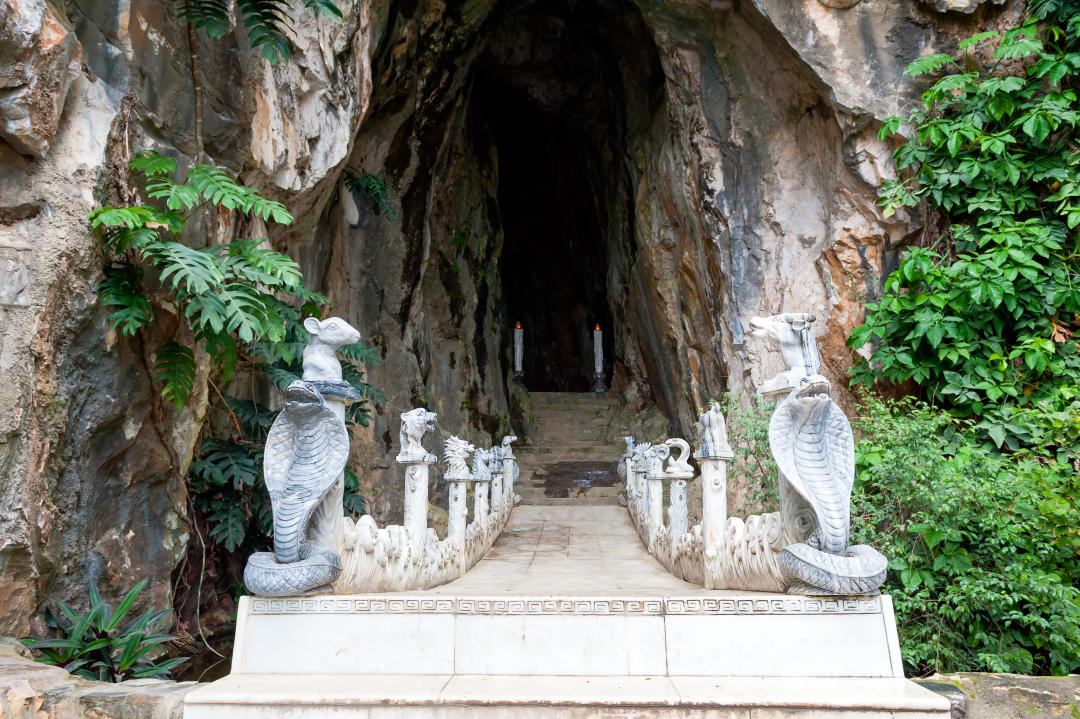
Your journey into the underworld begins by crossing the Nai Ha Bridge (Yin-Yang Bridge). This small stone bridge symbolically separates the world of the living from the world of the dead. According to legend, this is where souls are judged for the first time. The good are guided one way, while the sinful are pushed into a river of fire below. Flanked by imposing guardian statues, crossing this bridge sets a solemn and contemplative tone for the exploration ahead. It's a powerful and symbolic entry point that prepares you for the moral lessons contained within the cave.

3. Experience the contrast between Heaven and Hell paths

Inside Am Phu Cave, the path splits. One route leads down into darkness, while the other leads up toward the light. The "Hell" path is a winding, narrow descent through chambers filled with macabre scenes of punishment. In stark contrast, the "Heaven" path is a physically demanding, steep climb up a series of precarious-looking stairways. Those who make the challenging ascent are rewarded with a breathtaking view from an opening high up on the mountainside. This physical journey beautifully mirrors the spiritual concept: the path to hell is easy and downward, while the path to enlightenment requires effort and struggle.

Inside Am Phu Cave, visitors choose between an easy descent into “Hell” or a challenging climb toward “Heaven”

Inside Am Phu Cave, visitors choose between an easy descent into “Hell” or a challenging climb toward “Heaven”

4. Discover dramatic rock formations and natural cave scenery

Beyond its spiritual theme, Am Phu Cave is a stunning natural wonder. The cave is filled with incredible geological formations that have been shaped over millennia. You'll see massive limestone walls, glossy stalactites dripping from the ceiling, and colossal stalagmites rising from the floor. The cave's natural beauty provides a dramatic backdrop for the sculptures. The interplay of colored lights on the wet, shimmering rock surfaces creates an ethereal and mysterious atmosphere that is both beautiful and slightly unnerving, adding to the cave's powerful ambiance.

5. Learn Buddhist teachings through sculptures of the underworld

The cave is a living gallery of Buddhist iconography, with every sculpture telling a story. These are vivid depictions of scriptural teachings meant to provoke thought and reflection. You will find terrifying sculptures depicting specific punishments, such as demons boiling sinners in cauldrons, serpents devouring the unrighteous, and sinners being forced to climb thorn-covered trees. These graphic representations serve a clear purpose: to illustrate the direct consequences of negative actions like lying, stealing, or disrespecting one's elders.

Am Phu Cave showcases vivid Buddhist sculptures that illustrate moral lessons, using symbolic scenes of punishment to reflect the consequences of unethical actions

Am Phu Cave showcases vivid Buddhist sculptures that illustrate moral lessons, using symbolic scenes of punishment to reflect the consequences of unethical actions

6. Understand local beliefs about karma, judgment, and rebirth

A visit to Am Phu Cave is an immersion into Vietnamese folk beliefs about the afterlife. At the center of the main cavern stands the Scale of Justice, where souls are weighed. Good deeds are balanced against bad deeds to determine one's fate. This concept of a final, impartial judgment is a cornerstone of the experience. As you explore, you'll see how these beliefs are woven into the fabric of daily life and morality. The cave teaches that rebirth is not guaranteed to be favorable, your next life is determined by the balance of your actions in this one.

7. Reflect on moral lessons and the story of filial piety

Amidst the scenes of terror, there is also a profound story of love and devotion. The cave prominently features the story of Muc Kien Lien (Maudgalyayana), a disciple of the Buddha who journeyed through hell to save his mother from her suffering. Statues depicting his harrowing quest and ultimate success are placed throughout the cave. This narrative highlights the supreme virtue of filial piety respect and love for one's parents. It offers a message of hope, suggesting that even in the darkest of places, compassion and devotion can lead to salvation.

The cave also tells the story of Muc Kien Lien, whose journey to save his mother highlights the power of filial piety, compassion, and hope even in the darkest places

The cave also tells the story of Muc Kien Lien, whose journey to save his mother highlights the power of filial piety, compassion, and hope even in the darkest places

8. Visit the chambers depicting the 9 Kings of Hell and the 18 Levels of Hell

The most dramatic section of the cave details the courts of the underworld. The main cavern and its offshoots are dedicated to the Nice Courts of Hell, each presided over by a stern-faced King of Hell who judges a different type of sin. Surrounding these courts are scenes representing the "18 Levels of Hell", with each level reserved for a specific transgression. You'll see depictions of the Phuc Dien (Hall of Judgment) and scenes where souls face their punishments. This section is what gives Am Phu Cave its "Hell Cave" nickname and is the most graphic and memorable part of the journey.

9. Observe spiritual altars, Buddha statues, and folk worship practices

Am Phu Cave is an active place of worship, not just a museum. Tucked into nooks and crannies, you'll find numerous altars dedicated to various deities, such as the Buddha and Bodhisattvas, and local folk gods. You will see offerings of incense, fruit, and flowers left by locals praying for their ancestors or seeking blessings. These altars, often illuminated by a single spotlight in the darkness, provide moments of serene beauty and spiritual calm amidst the chaos of the underworld scenes. It reminds visitors of the ever-present path to peace and enlightenment.

Beyond a museum, Am Phu Cave remains an active place of worship, where hidden altars, incense offerings, and soft light create moments of peace and spiritual reflection

Beyond a museum, Am Phu Cave remains an active place of worship, where hidden altars, incense offerings, and soft light create moments of peace and spiritual reflection

10. Capture atmospheric photos inside one of Da Nang’s most striking caves

For photographers, Am Phu Cave is a dream. The combination of dramatic, low-key lighting, rising steam, intricate statues, and glossy rock textures provides endless opportunities for stunning photos. The contrast between the dark, red-lit pits of "Hell" and the bright, sun-drenched exit of "Heaven" allows for powerful visual storytelling. Be sure to capture the scale of the caverns, the detailed expressions on the statues, and the rays of light piercing through openings in the cave ceiling. It’s one of the most photogenic and atmospheric locations in all of Da Nang.

How to get to Am Phu Cave

Getting to Am Phu Cave is straightforward as it's a major landmark located on the main coastal road connecting Da Nang and Hoi An. The cave is situated at Gate 2 of the Marble Mountains complex, which is right next to the main parking area for cars and motorbikes.

From Da Nang City center

The journey from the center of Da Nang is quick and easy, with several scenic routes available.

  • Distance: Approximately 11 km
  • Time: 15-20 minutes
  • Suggested routes:
    • Dragon Bridge → Vo Van Kiet → Ngo Quyen / QL14B → Le Van Hien → Huyen Tran Cong Chua Street
    • Dragon Bridge → Tran Thi Ly Bridge → QL14B → Nguyen Phuoc Lan → Mai Dang Chon → Le Van Hien → Huyen Tran Cong Chua Street
    • Dragon Bridge → My Khe Beach → Vo Nguyen Giap → Truong Sa → Pham Huu Nhat → Le Van Hien Street (longer but very scenic)

From Da Nang International Airport

If you're coming directly from the airport, a taxi or ride-hailing service is the most convenient option.

  • Distance: Approximately 12 km
  • Time: 20-25 minutes
  • Recommended Route: Da Nang International Airport → Nguyen Van Linh Street → Nguyen Tri Phuong Street → Le Van Hien Street → Huyen Tran Cong Chua Street
  • Taxi and ride-hailing apps: The most convenient options, especially for travelers with luggage
From Da Nang International Airport, Am Phu Cave is about 12 km away and can be easily reached in 20-25 minutes by taxi or ride-hailing services via major city roads

From Da Nang International Airport, Am Phu Cave is about 12 km away and can be easily reached in 20-25 minutes by taxi or ride-hailing services via major city roads

From Hoi An Ancient Town

The cave is a popular stop for those traveling between Hoi An and Da Nang.

  • Distance: Approximately 19 km
  • Time: 25-30 minutes
  • Best Route: Hai Ba Trung Street → Lac Long Quan / Vo Nguyen Giap → Truong Sa coastal road → Le Van Hien Street → Huyen Tran Cong Chua Street
  • The coastal route: Recommended for lighter traffic and better views

Transportation options

You have several convenient ways to get to the Hell Cave Da Nang.

  • Taxi/Grab: This is the easiest and most comfortable option. A one-way trip from Da Nang City center costs around 150,000 - 200,000 VND. From Hoi An, expect to pay 250,000 - 350,000 VND.
  • Motorbike: For adventurous travelers, renting a motorbike offers the most flexibility. Rentals cost about 100,000 - 150,000 VND per day. Parking near Gate 2 is available for a small fee of around 10,000 VND.
  • Guided tours: Many tour operators in Da Nang and Hoi An offer half-day trips to the Marble Mountains, which almost always include a visit to Am Phu Cave. This is a great hassle-free option.

Getting to Am Phu Cave inside the Marble Mountains

Once you arrive at the Marble Mountains, head towards Gate 2. This is located on Huyen Tran Cong Chua Street. The ticket counter for both the mountain and Am Phu Cave is here. The entrance to the cave is clearly marked and located at ground level, just past the ticket booth and near the base of the large glass elevator.

Nearby attractions to the Am Phu Cave Da Nang

Your visit to Am Phu Cave can easily be combined with other fantastic sights in the area.

Attractions within the Water Mountain (Thuy Son), Marble Mountains

Am Phu Cave is just one part of the larger Thuy Son complex. After exploring the underworld, you can take the elevator or stairs to the top of the mountain to discover more. For a full tour, check out GTrip's complete guide to the Marble Mountains.

  • Linh Ung Pagoda: An ancient and beautiful pagoda with a large courtyard and stunning views. It is a peaceful place for visitors to pray, meditate, and enjoy the tranquil atmosphere of the Marble Mountains.
  • Xa Loi Tower: A multi-tiered Buddhist stupa that is a prominent landmark on the mountain. Its elegant structure reflects traditional Buddhist architecture and offers great photo opportunities.
  • Huyen Khong Cave: A massive, breathtaking cavern with a giant Buddha statue illuminated by natural light from a collapsed ceiling. The interplay of light and shadow creates a sacred, almost mystical ambiance inside the cave.
  • Van Thong Cave: A smaller cave with a narrow passage known as the “Way to Heaven”. Climbing through this passage rewards visitors with panoramic views over Da Nang and the surrounding coastline.
After visiting Am Phu Cave, continue exploring the Thuy Son complex to discover pagodas, and caves that showcase the Marble Mountains’ spiritual beauty

After visiting Am Phu Cave, continue exploring the Thuy Son complex to discover pagodas, and caves that showcase the Marble Mountains’ spiritual beauty

Attractions near the Marble Mountains

The strategic location of the Marble Mountains makes it a perfect anchor point for a day of exploration.

  • My Khe Beach: One of Da Nang's most famous beaches, located just a 5-10 minute drive away. With its long stretch of soft sand and clear water, it’s an ideal spot to unwind, swim, or enjoy fresh seafood by the sea.
  • Hoi An Ancient Town: This UNESCO World Heritage Site is only a 25-30 minute drive south. Its lantern-lit streets, historic houses, and riverside cafes offer a charming contrast to the natural scenery of the Marble Mountains.
  • Non Nuoc Stone Carving Village: Situated at the foot of the Marble Mountains, this village boasts a 400-year-old tradition of crafting exquisite sculptures from the local marble. Visitors can watch skilled artisans at work and purchase unique handmade souvenirs.
Thanks to its central location, the Marble Mountains offer easy access to nearby highlights like My Khe Beach for a full day of exploration

Thanks to its central location, the Marble Mountains offer easy access to nearby highlights like My Khe Beach for a full day of exploration

Practical tips for visitors when visiting Am Phu Cave

To ensure you have a safe, comfortable, and enjoyable experience exploring Am Phu Cave, keep these essential tips in mind.

  • Buy the correct ticket: Remember that the Am Phu Cave ticket is separate from the main entrance fee to the Marble Mountains. You must purchase both.
  • Wear appropriate attire: As this is a spiritual site, dress respectfully. This means covering your shoulders and knees. Lightweight, modest clothing is ideal.
  • Footwear is crucial: The stone steps inside the cave are often wet, uneven, and extremely slippery. Comfortable footwear with good grip is essential, avoid wearing sandals or flip-flops.
  • Be prepared for a climb: The path to "Heaven" is very steep and narrow. It may not be suitable for those with mobility issues, a fear of heights, or claustrophobia.
  • Bring cash: Ticket booths and small vendors in the area may not accept credit cards. Cash in Vietnamese dong (VND) is necessary for tickets, parking, and refreshments.
  • Suitability for children: While fascinating, the graphic depictions of hell can be frightening for young children. Parents should use their discretion.
  • Check for closures: During periods of very heavy rain, parts of the cave may be temporarily closed for safety reasons.
Keep these essential tips in mind to ensure a safe, respectful, and enjoyable visit to Am Phu Cave, from tickets and attire to footwear, safety, and suitability for children

Keep these essential tips in mind to ensure a safe, respectful, and enjoyable visit to Am Phu Cave, from tickets and attire to footwear, safety, and suitability for children

Am Phu Cave is an extraordinary destination that offers far more than a typical cave visit. It is a journey into the depths of Buddhist cosmology, a place of striking artistry, and a vivid reflection on morality and rebirth. While in Da Nang, don’t miss the chance to explore this captivating underworld and be sure to wear comfortable shoes and bring your sense of adventure. To experience it seamlessly alongside other nearby highlights, consider joining curated Da Nang tours for deeper cultural insight and smooth logistics. For more expert travel guides and insider tips on discovering Vietnam’s most remarkable destinations, explore the rest of the GTrip blog.

Recently Viewed Trips