
Monday, October 19, 2026
The Ha Chuong Assembly Hall stands as a vibrant testament to the enduring cultural and spiritual legacy of the Fujian Chinese community in Ho Chi Minh City. Tucked away in Cho Lon (Chinatown), this active place of worship offers a breathtaking journey into a world of intricate architecture, fragrant incense, and centuries-old traditions. While less famous than its neighbor, the Thien Hau Pagoda, it provides a more serene and equally stunning experience. This GTrip guide covers everything you need to know, such as its fascinating history, architectural wonders, and practical tips for planning your visit.
Table of Content
An overview of Ha Chuong Assembly Hall
- Address: 802 Nguyen Trai Street, Cho Lon Ward (formerly Ward 14, District 5), Ho Chi Minh City
- Opening hours: 6:00 AM - 4:00 PM, daily
- Entrance fee: Free
- Best time to visit: Early morning (6:00 AM - 9:00 AM)
Often referred to by its alternative name, Nhi Phu Temple, the Ha Chuong Assembly Hall is one of the oldest and most artistically significant Chinese assembly halls in Saigon. It serves as both a community hub and a sacred space dedicated to the goddess Mazu. Its authentic atmosphere and remarkable preservation make it a must-see for anyone exploring the rich heritage of Ho Chi Minh City's Chinatown.
History of Ha Chuong Assembly Hall
The history of the Ha Chuong Assembly Hall is deeply intertwined with the story of Chinese migration to southern Vietnam. It was founded in the late 18th century by immigrants from two prefectures in China's Fujian province: Quanzhou and Zhangzhou. This origin is immortalized in its traditional name, Nhi Phu Temple (二府廟), which translates to "Temple of the two prefectures". Initially constructed as a gathering place for fellow countrymen to provide mutual support, conduct business, and preserve their cultural identity, it quickly evolved into a vital spiritual center.
The hall is primarily dedicated to Thien Hau (Mazu), the Goddess of the Sea. As the Fujianese were a seafaring people, they prayed to Mazu for protection during their perilous voyages across the South China Sea. Over the centuries, the hall underwent several renovations, with a major restoration completed in 1901 that gave it much of its present-day ornate appearance. Today, it remains an active place of worship and a powerful symbol of the Fujian community's contribution to the cultural fabric of Ho Chi Minh City.
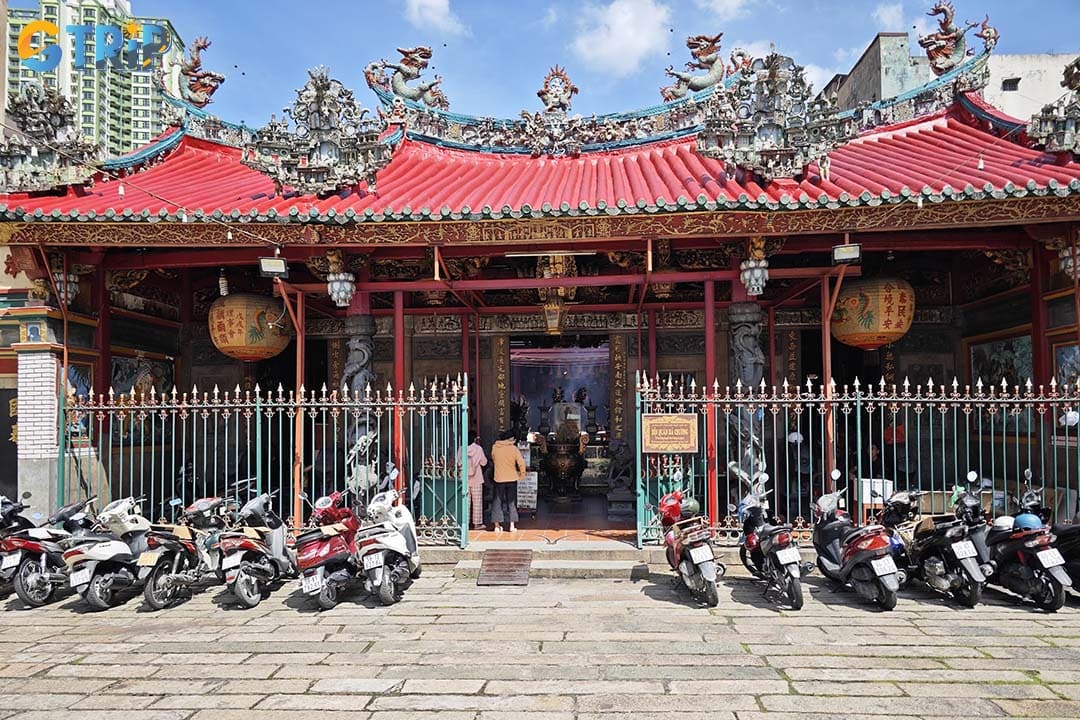
Ha Chuong Assembly Hall is primarily dedicated to Thien Hau (Mazu), the Goddess of the Sea
Architecture of Ha Chuong Assembly Hall
Ha Chuong Assembly Hall features the classic architectural style of traditional Chinese temples. The complex covers a total area of about 1,500 square meters, with a 300-square-meter front courtyard that provides ample space for community festivals and religious ceremonies.
Spatial layout and natural ventilation
The main structure is divided longitudinally into three consecutive sections: the front hall, the main hall, and the rear hall. A highly practical feature of this layout is the inclusion of open-air courtyards (skylights) placed strategically between the buildings. When walking through the temple, you will notice those open spaces serve a vital function. They maximize natural sunlight, regulate the airflow, and quickly ventilate thick incense smoke during busy holidays and full moon days.
The boat-shaped roof and ceramic ornamentation
Looking up from the courtyard, visitors can see the complex roofing system. The entire roof is covered with traditional tube tiles, bordered by green enameled fringes. The roof of the front hall is the most structurally complex. The central roof and the side roofs are built at different heights, creating a tiered effect with four main peaks and eight upward-curved eaves. This specific design gives the building the silhouette of a boat riding the waves. The roof ridges are heavily decorated with colorful ceramic figurines, including two dragons fighting for a pearl, a rider on a mythical horse leaping through a ring of fire, as well as miniature citadels, soldiers, and phoenixes.
Monolithic stone carvings at the facade
Approaching the main entrance, the focus shifts to intricate stonework. The front doors are flanked by two imposing stone unicorns and decorative stone window frames. The highlight of the facade is the pair of large monolithic stone pillars at the front hall. Craftsmen carved deep 3D reliefs into the solid stone, depicting a dragon ascending to heaven while carrying four of the legendary Eight Immortals on its back. The hexagonal bases of these pillars are equally detailed, featuring traditional motifs such as plum blossoms with birds, and squirrels climbing grapevines.
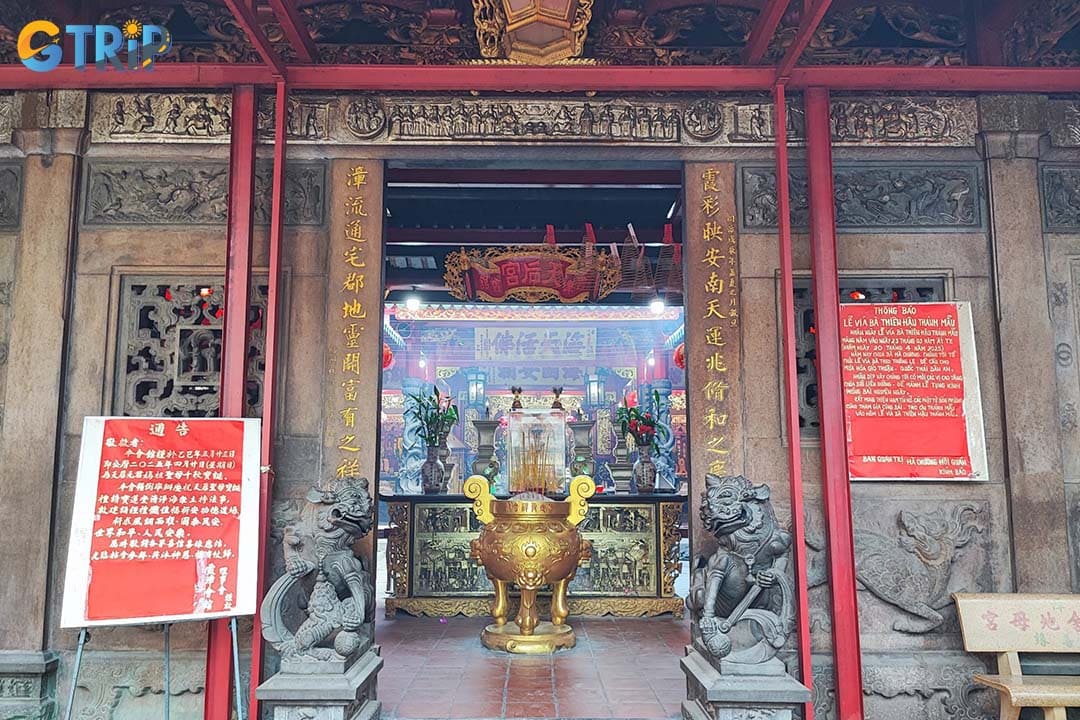
Ha Chuong Assembly Hall features the classic architectural style of traditional Chinese temples
Interior design and deities' shrines
Stepping inside, the interior is dominated by red-painted columns and ceilings. In Chinese culture, this color is widely used in spiritual spaces to symbolize luck and vitality. The ceiling is further decorated with traditional lanterns bearing Chinese characters.
The worship spaces are strictly organized:
- The center (main hall): Dedicated to Mazu (Thien Hau), the Goddess of the Sea.
- The side shrines: Dedicated to the Goddess of Fertility and the Earth God. Other altars throughout the hall honor figures such as Guanyin, Guan Yu, and the Monkey King (Sun Wukong). Notably, the temple also has a shrine dedicated to Bao Zheng (Bao Cong), an incorruptible official from the Song Dynasty. Beside him are his loyal subordinates, including Zhan Zhao (Trien Chieu), Gongsun Ce (Cong Ton Tien Sinh), Zhang Long (Truong Long), and Zhao Hu (Trieu Ho).
The interior also houses a significant historical artifact: an antique bronze bell cast in 1868, engraved with lotus flowers, water waves, and Chinese inscriptions.
Exterior Feng Shui: The 1885 fish pond
A unique architectural element lies completely outside the main complex. Just across the street from the assembly hall sits a fish pond built in 1885. The placement of this pond is based on traditional Feng Shui principles. The water element located directly in front of the building is designed to "gather energy and secure the spiritual flow" of the area. Practically, the pond also helps cool the surrounding environment, adding a sense of tranquility to the temple's main entrance.
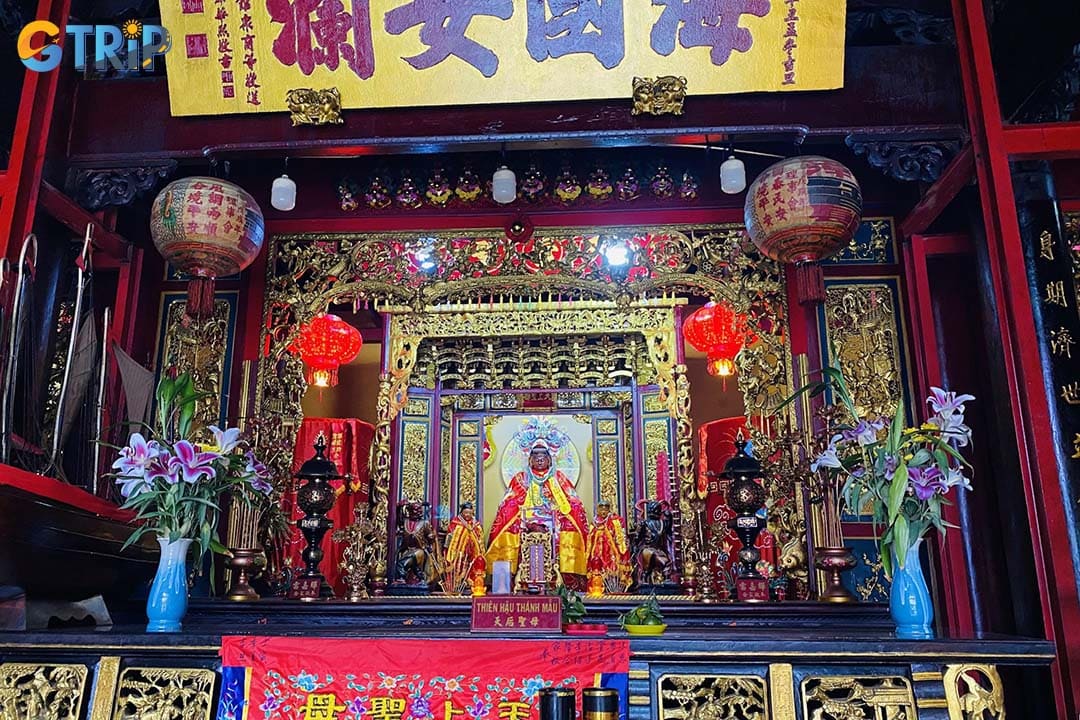
The main hall is where dedicated to Mazu (Thien Hau), the Goddess of the Sea that you can worship
Things to do at Ha Chuong Assembly Hall
Beyond its historical architecture, visiting Ha Chuong Assembly Hall offers a hands-on experience of the local Chinese community's spiritual life. Here are the top activities you should not miss during your visit:
1. Light incense and pray for blessings
Start your visit by purchasing traditional coil incense. You can light it at the main hall to pray for peace, health, and good fortune from Mazu (Goddess of the Sea). Alternatively, head to the altar of Bao Zheng to pray for fairness and integrity. Immersing yourself in this quiet, incense-scented atmosphere is the best way to experience the authentic spiritual life of the local Chinese community.
2. Admire the relief carvings and ceramic roofs
Take a closer look at the intricate details that make this temple visually stunning. Stop at the front hall to examine the two monolithic stone pillars, where craftsmen carved deep 3D reliefs of dragons. Next, step back and look up at the roof ridges. You will spot a colorful array of ceramic figurines, including dragons, phoenixes, and miniature soldiers, showcasing exceptional traditional artistry.
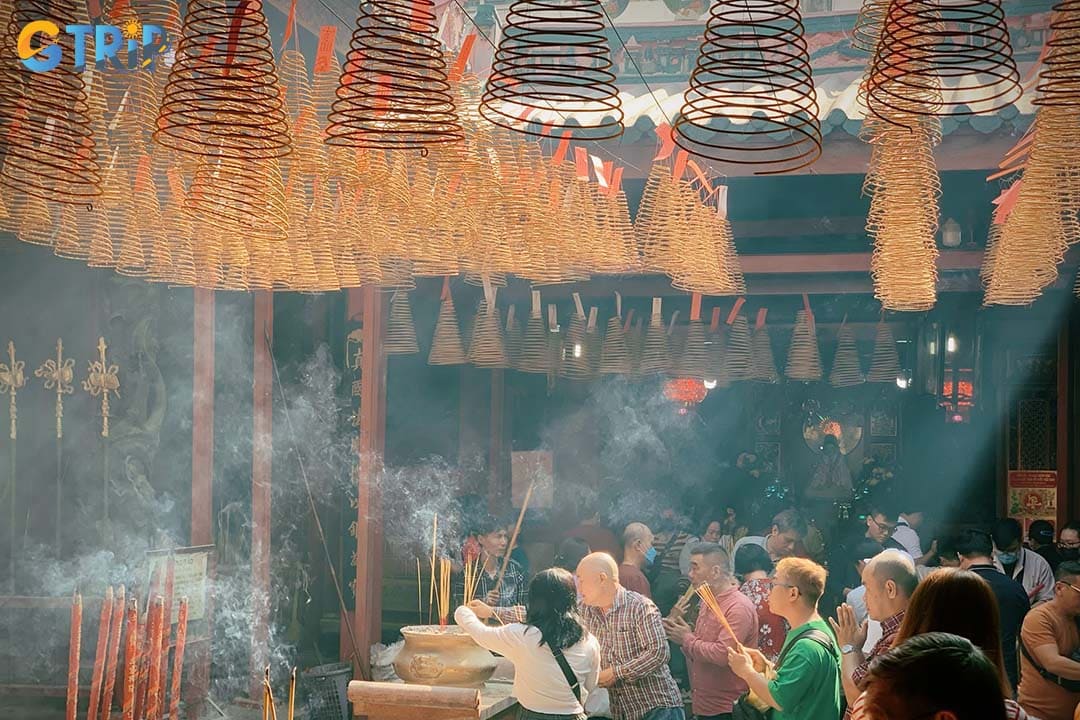
One of the main activities you can do when visiting the Ha Chuong Assembly Hall is lighting incense and praying for blessings
3. Discover the 1868 antique bronze bell
Make sure to locate the antique bronze bell displayed inside the hall. Cast in 1868, this well-preserved artifact is a key piece of the temple's history. Take a moment to examine its surface carefully. You will see precise engravings of lotus flowers, water waves, and traditional Chinese characters. Viewing this bell up close gives you a tangible connection to the assembly hall’s long heritage.
4. Take photos of classic Chinese architecture
Ha Chuong Assembly Hall offers excellent photography opportunities. For the best natural lighting, stand in the open-air skylights located between the halls. Point your camera upwards to capture the rows of traditional red lanterns hanging from the ceiling. Outside, the main facade is another great photo spot. You can frame your shots using the massive wooden doors and the two imposing stone unicorns guarding the entrance.
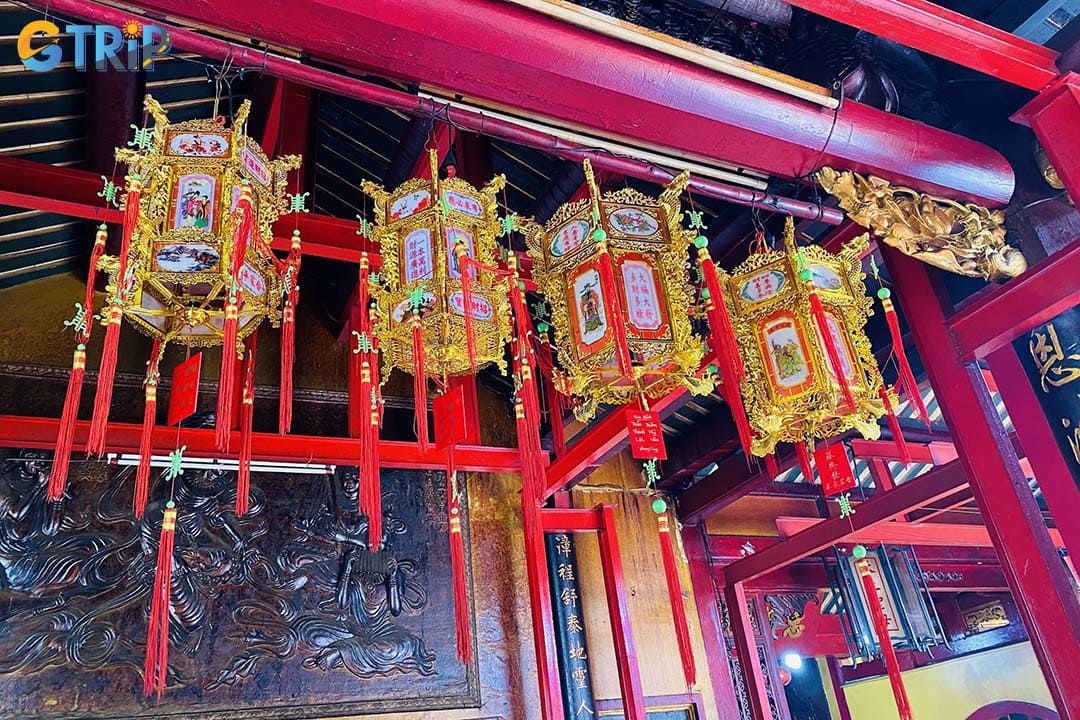
Ha Chuong Assembly Hall offers excellent photography opportunities
5. Relax by the feng shui fish pond
After exploring the interior, step outside and cross the street to find the historic fish pond, built in 1885. According to traditional Feng Shui principles, placing a water feature directly in front of the temple gathers positive energy. Today, it serves as a peaceful rest stop. You can sit by the water, watch the fish, and take a quiet break before continuing your city tour.
6. Visit during traditional festivals
To see the temple at its most vibrant, plan your visit around the lunar calendar. The assembly hall hosts two major annual events: Mazu’s birthday (the 23rd day of the 3rd lunar month) and the Ghost Festival (the 9th day of the 7th lunar month). If you visit during these major festivals, or on the 1st and 15th of any lunar month, you will find the courtyard packed with locals. It is the best time to see the ceilings completely filled with giant burning coil incense and brightly lit red lanterns.
How to get to Ha Chuong Assembly Hall
Located at 802 Nguyen Trai Street in Cho Lon (Chinatown), the assembly hall is around 4-5 km from the HCMC center. The most direct routes from the central area are Tran Hung Dao → Nguyen Trai or Vo Van Kiet Boulevard → Hai Thuong Lan Ong → Nguyen Trai, typically taking about 20-30 minutes depending on traffic. Its central Chinatown location also makes it easy to combine with nearby temples, markets, and historic streets in the same visit.
- Taxi/Ride-hailing (Grab, Xanh SM): The most convenient option from the HCMC center. Expect 120,000-180,000 VND (~$4.60-$6.90) one way depending on traffic and pickup point.
- Public bus: Several routes stop along Nguyen Trai and nearby Chinatown streets. Tickets typically cost around 9,000 VND (~$0.34), making this the most budget-friendly option.
- Motorbike (rental or ride-hailing): A flexible choice for navigating traffic and exploring the area. A ride from the center costs about 50,000-80,000 VND ($1.90-$3.10), while daily rentals average 120,000-180,000 VND ($4.60-$6.90).
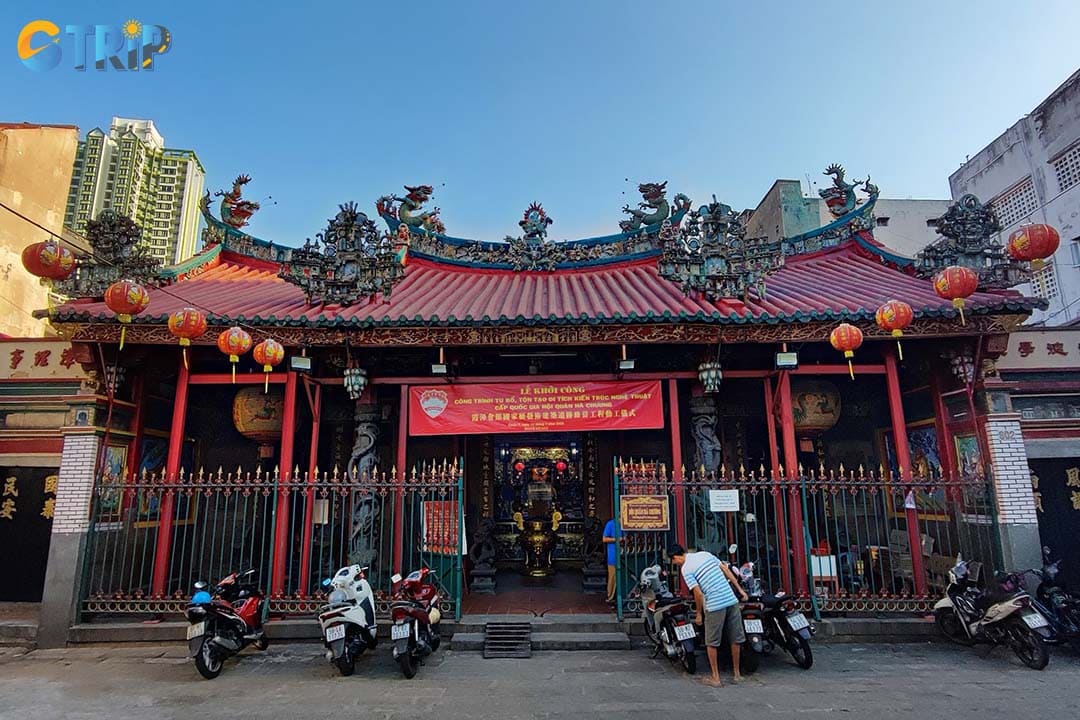
You can easily get to Ha Chuong Assembly Hall by many means of transport
Nearby attractions to Ha Chuong Assembly Hall
The Ha Chuong Assembly Hall is located in a neighborhood rich with cultural sites. You can easily combine your visit with a tour of these other nearby attractions.
- China Town (200m): This is the sprawling, energetic heart of Ho Chi Minh City's Chinese community. Explore the Binh Tay Market and wander through streets filled with traditional medicine shops, authentic eateries, and vibrant sights and sounds.
- St Francis Xavier Church (400m): A truly unique landmark, this church blends Chinese and European architectural styles. It is historically significant as the place where President Ngo Dinh Diem was arrested in 1963.
- Quan Am Pagoda (600m): One of the oldest pagodas in the city, this beautiful temple is dedicated to Guan Yin, the Goddess of Mercy. It's another stunning example of classic Chinese temple architecture.
- Thien Hau Pagoda (650m): Arguably the most famous Chinese temple in the city, this sprawling complex is also dedicated to Mazu. While more crowded, its scale and magnificent interior make it an essential stop.
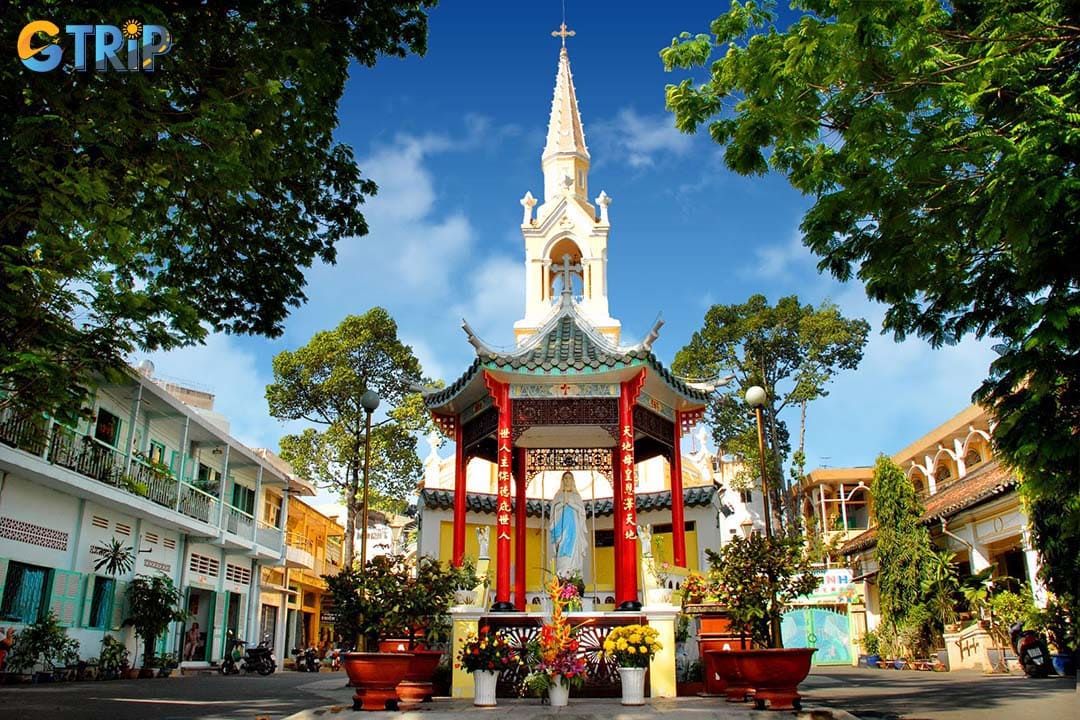
There is a St Francis Xavier Church near the Ha Chuong Assembly Hall that you can explore
Practical tips for visiting Ha Chuong Assembly Hall in Saigon
To ensure a smooth and respectful visit, keep these practical tips in mind.
- Dress code: This is an active place of worship. Visitors must dress modestly, ensuring shoulders and knees are covered. Avoid wearing shorts, short skirts, or tank tops.
- Respectful conduct: Maintain a quiet and respectful demeanor inside the temple. Speak in low tones and avoid loud conversations. Walk slowly and do not run or rush through the sacred spaces.
- Photography: Photography is generally permitted, but never use a flash as it can damage the delicate, centuries-old artifacts. Be mindful of worshippers and avoid taking photos of people without their explicit permission.
- Donations: While there is no entrance fee, small donations are greatly appreciated. Look for donation boxes placed near the altars. These contributions go directly towards the temple's upkeep and maintenance.
- Combine your visit: Plan to spend at least half a day in Cho Lon. The Ha Chuong Assembly Hall can be visited in under an hour, so it's best to combine it with a walking tour of the other nearby pagodas, churches, and markets.
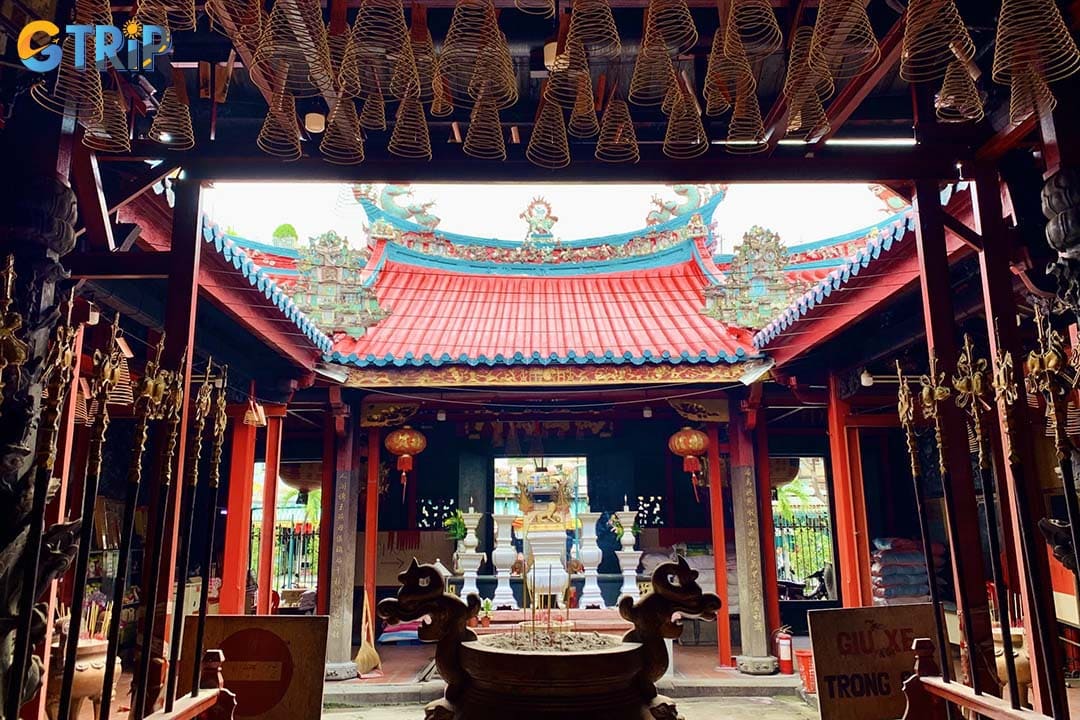
Remember practical tips to have a good trip to Ha Chuong Assembly Hall
Read more:
The Ha Chuong Assembly Hall is more than just a historical building. It is a living, breathing sanctuary that offers a profound glimpse into the spiritual soul of Ho Chi Minh City. Its breathtaking artistry, serene atmosphere, and authentic cultural practices set it apart as a truly special destination. While larger temples may draw bigger crowds, the quiet dignity and exquisite detail of this Fujianese gem provide a more intimate and rewarding experience. On your next trip with GTrip, make sure to step off the beaten path and discover the timeless beauty of the Ha Chuong Assembly Hall, a true hidden treasure waiting to be explored. For travelers looking to experience the city's heritage more deeply, our Ho Chi Minh City tours offer the perfect opportunity to uncover cultural landmarks, hidden stories, and authentic local life beyond the usual tourist routes.
Custom Your Journey

Other Attractions
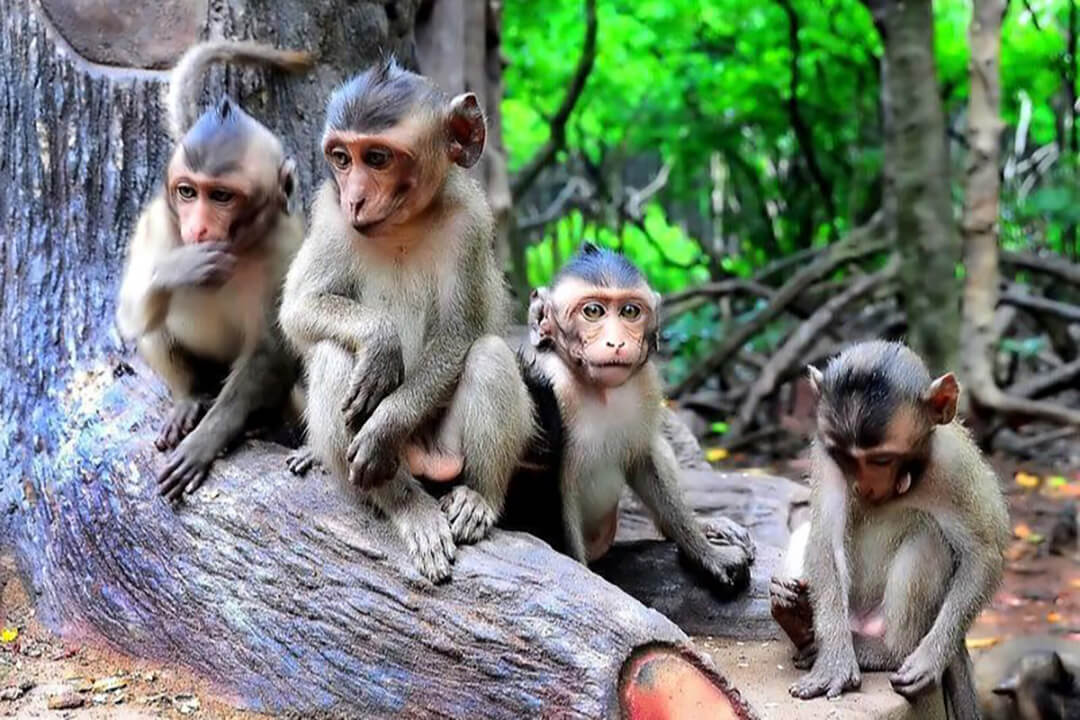
Can Gio Monkey Island in Ho Chi Minh City: Tickets, Things to Do & Travel Guide
Can Gio Monkey Island
Can Gio Monkey Island in Ho Chi Minh City offers a refreshing escape from the city’s buzzing motorbike chaos. Just a short distance from the center, Can Gio welcomes you with lush mangrove forests, winding waterways, and a fascinating history. Here, you can meet playful long-tailed macaques, drift through tranquil channels, and explore remnants of a wartime guerrilla base.
Can Gio Monkey Island in Ho Chi Minh City: Tickets, Things to Do & Travel Guide
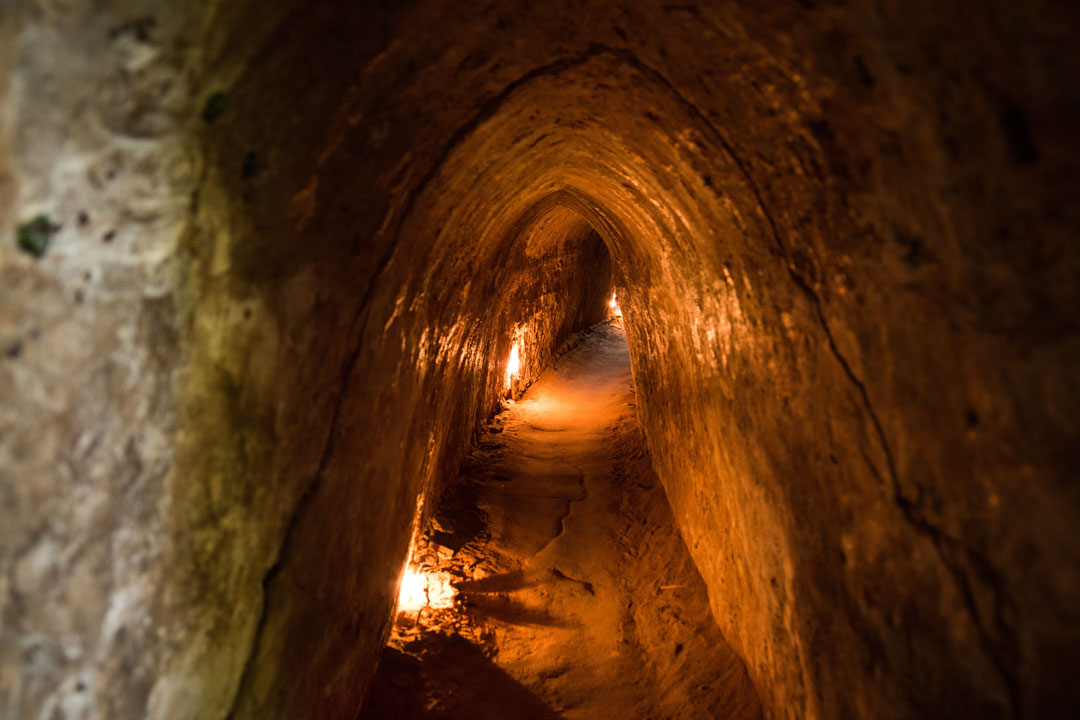
Cu Chi Tunnels: History, Architecture, Things To Do & Travel Guide
Cu Chi Tunnels
The Cu Chi Tunnels, located at TL15, Phu Hiep, Cu Chi District, Ho Chi Minh City, are a vast underground network of strategic passages, shelters, supply routes, and defensive traps.
Ho Chi Minh City
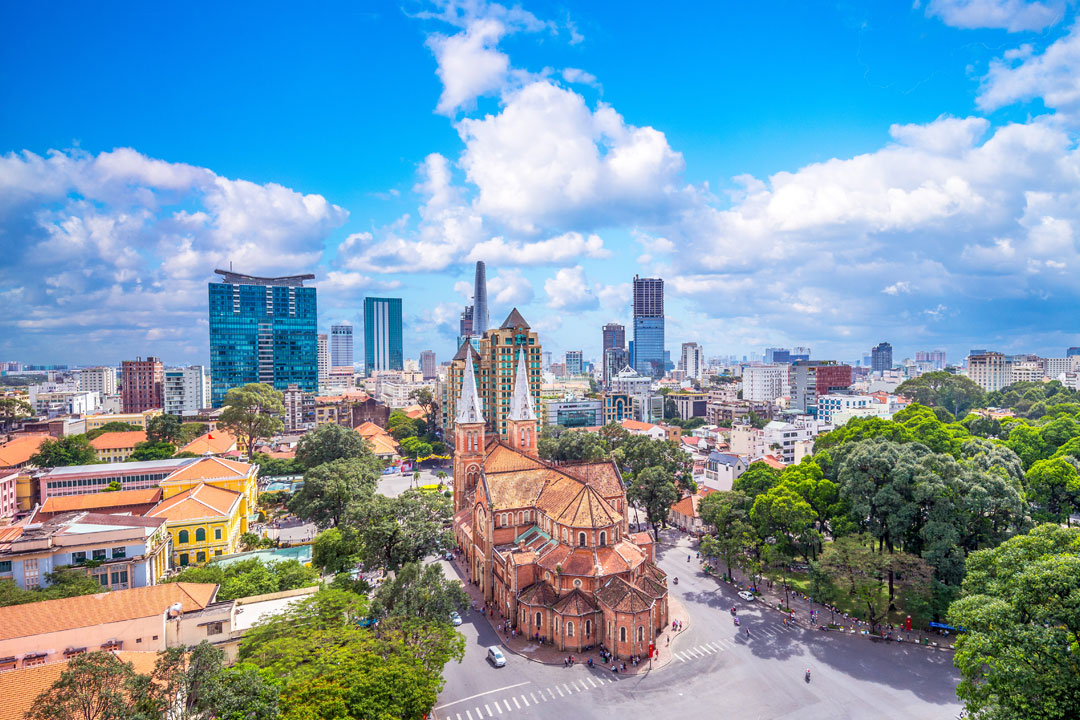
Ho Chi Minh City, known as the "Pearl of the Far East," attracts both domestic and foreign tourists with its unique and diverse destinations.
Tran Quoc Pagoda: History, Architecture, Significance & Travel Guide
Tran Quoc Pagoda
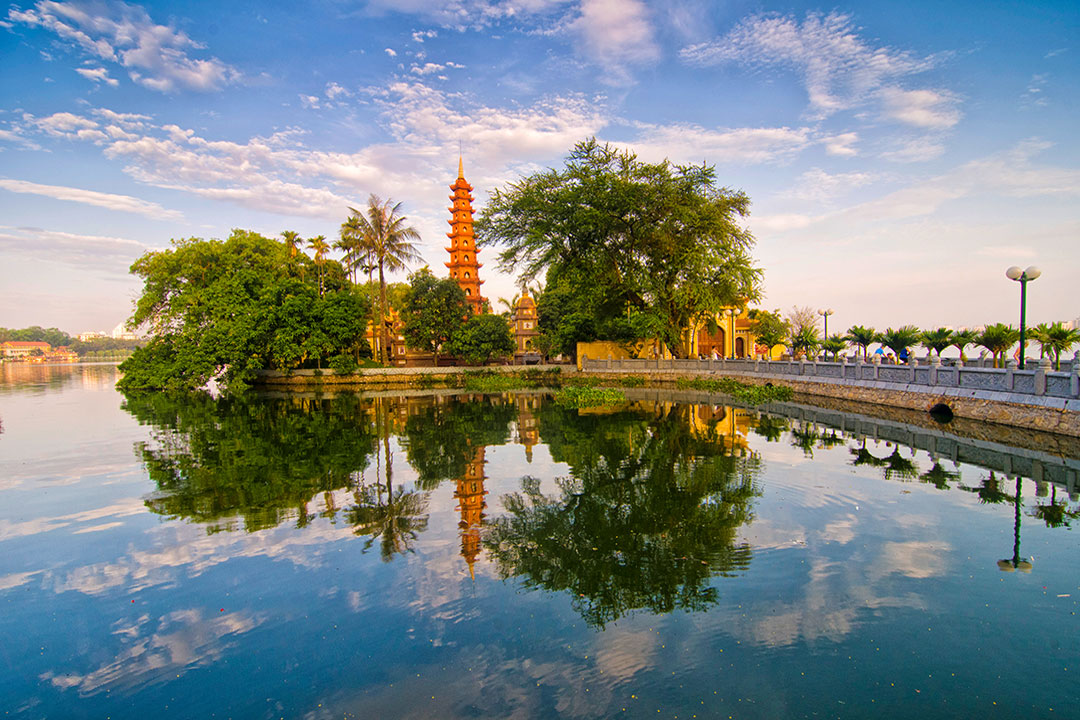
Nestled on the tranquil shores of West Lake, Tran Quoc Pagoda is the oldest Buddhist temple in Hanoi, with a history spanning over 1,500 years. Built in the 6th century under Emperor Ly Nam De, this sacred site reflects Vietnam’s Buddhist evolution while preserving its spiritual and architectural grandeur.