
Monday, October 19, 2026
Minh Huong Gia Thanh Communal House is a captivating historical treasure tucked away in the bustling heart of Ho Chi Minh City's Cho Lon, or Chinatown. More than just a beautiful building, this site is a living testament to the unique cultural identity of the Minh Huong people. It is a community of Chinese-Vietnamese who have shaped the city's history for centuries. While other temples in Saigon might draw larger crowds, Minh Huong Gia Thanh offers a quieter, more profound journey into a past where cultures merged to create something entirely new. It stands as a vital cultural landmark, preserving stories of migration, adaptation, and heritage in its intricately carved beams and serene courtyards. In this complete guide by GTrip, we'll cover everything you need to know for your visit, such as its fascinating history, unique architecture, practical tips on how to get there, and what to see nearby.
Table of Content
Overview of the Minh Huong Gia Thanh Communal House
Minh Huong Gia Thanh Communal House, often referred to as Minh Huong Assembly Hall, is one of the oldest communal houses in Saigon. It reflects the long-standing presence of the Minh Huong community, descendants of Chinese migrants who integrated into Vietnamese society. Located in the historic Cho Lon area, the site stands out for its calm atmosphere and traditional architecture, offering a contrast to the busy streets outside. It’s a meaningful stop for those interested in local history, culture, and religious practices in southern Vietnam.
Where is Minh Huong Gia Thanh Communal House in Saigon?
Address: No. 380, Tran Hung Dao Street, Cho Lon Ward (formerly Ward 11, District 5), Ho Chi Minh City
Minh Huong Gia Thanh Communal House is located in Cho Lon Ward, the historic Chinatown of Ho Chi Minh City. This area is well known for its temples, old shophouses, and long-established Chinese-Vietnamese community. Positioned along Tran Hung Dao Street, the communal house is easy to reach and fits naturally into a walking route through Cho Lon’s cultural landmarks. Despite the busy street outside, the space inside remains calm and reflective.
Opening hours and entrance fee
Planning your visit is straightforward, as the communal house is both accessible and welcoming to all visitors.
- Opening hours: 8:00 AM - 12:00 PM, daily
- Entrance fee: Free
Minh Huong Gia Thanh Communal House is open daily with limited hours, so visiting in the morning is recommended. The site is still actively used for worship, which adds to its authentic atmosphere. There is no entrance fee, making it an easy cultural stop while exploring Cho Lon. Visitors should dress modestly and keep a respectful tone during their visit.
What makes the Minh Huong Communal House unique?
Minh Huong Gia Thanh Communal House boasts a rare uniqueness as a perfect intersection between Southern Vietnamese architecture and Chinese expatriate culture. Unlike typical Chinese assembly halls, it does not worship Chinese deities but venerates Vietnamese generals and mandarins.
The features that make this relic truly one-of-a-kind include:
- Worshipping a Vietnamese general: The principal deity is Lord Nguyen Huu Canh, the founder of Minh Huong village, revered as the Tutelary God.
- Purely Vietnamese architecture: Utilizing the traditional xuyen trinh (pass-through tie-beam) wooden frame and a five-bay layout, deeply imbued with the Southern communal house style.
- Possessing royal antiques: Preserving the "Thien tuc kha phong" horizontal lacquered board bestowed by King Tu Duc in 1863, alongside dozens of unique 19th-century artifacts.
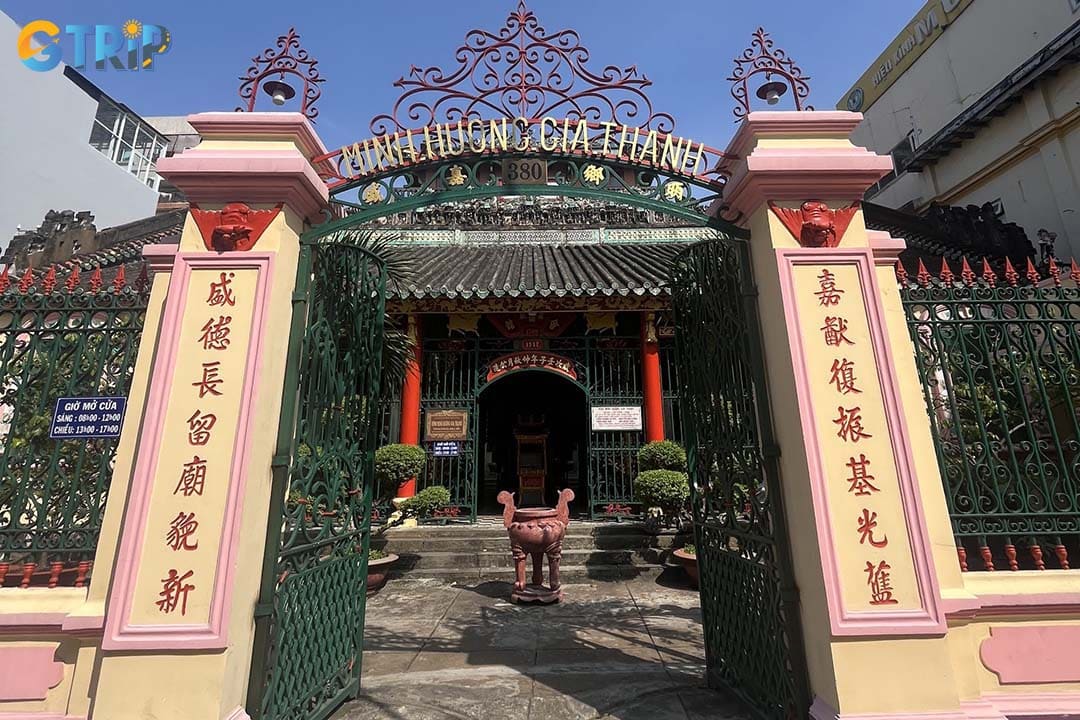
Minh Huong Gia Thanh Communal House reflects the long-standing presence of the Minh Huong community
History of the Minh Huong Communal House
Spanning over three centuries on the ancient land of Gia Dinh (now Ho Chi Minh City), the formation and development of the Minh Huong Communal House are deeply intertwined with the historical ups and downs of the Minh Huong community. Evolving from a humble village administrative house to a National Architectural and Artistic Relic, this monument has witnessed several significant chronological milestones.
| Year | Historical milestone |
|---|---|
| 1698 | Lord Nguyen Huu Canh went to the South to establish Gia Dinh prefecture, allowing some Chinese descendants who had resided there for a long time to establish Minh Huong village in Phien Tran garrison. |
| 1789 | According to the Village Convention, "Minh Huong village" was officially established. Immediately after, the community contributed to building a communal house as a place for worship and a workplace for village officials. |
| 1808 | King Gia Long bestowed the name "Gia Thanh duong" (Gia Thanh Hall), and since then, the place has been known as Minh Huong Gia Thanh. |
| 1839 | On the foundation of the old working house, the people of Minh Huong village built and restored the communal house. |
| 1867 | When the French government changed the administrative structure and merged the village into Saigon - Cho Lon, the communal house was no longer the village's administrative office. It shifted its function to the Assembly Hall of the Minh Huong Gia Thanh association. |
| 1901 & 1962 | The communal house underwent major restorations. Specifically in 1962, an upper floor was added to the main hall, and some modern materials like cement and ceramic tiles were used. |
| January 7, 1993 | The communal house was officially recognized by the Ministry of Culture as a National Architectural and Artistic Relic. |
Architecture of the Minh Huong Communal House
The communal house is built on a raised foundation featuring a five-bay house layout and brick walls. The wooden frame is sturdily constructed using the xuyen trinh (pass-through tie-beam) structure, reflecting the traditional nha ruong (wooden paneled house) style combined with Chinese carving arts.
The exterior and roof
From outside the gate, visitors can clearly observe the grand and ancient appearance of the structure. The exterior stands out with brick walls and a roof covered in tube tiles, while the roof edges are clad in glazed lapis lazuli tiles (blue tiles). The most spectacular highlight of the roof is the system of miniature statues and vibrant colored ceramic reliefs. The roof ridge is magnificently decorated with figures of "two dragons fighting for a pearl", "carp transforming into a dragon", statues of the Sun God and Moon Goddess, and excerpts from Chinese folklore plays. All these highly artistic ceramic works were produced by the renowned Dong Hoa pottery kiln (Cay Mai ceramics) in the Year of the Ox (1901).
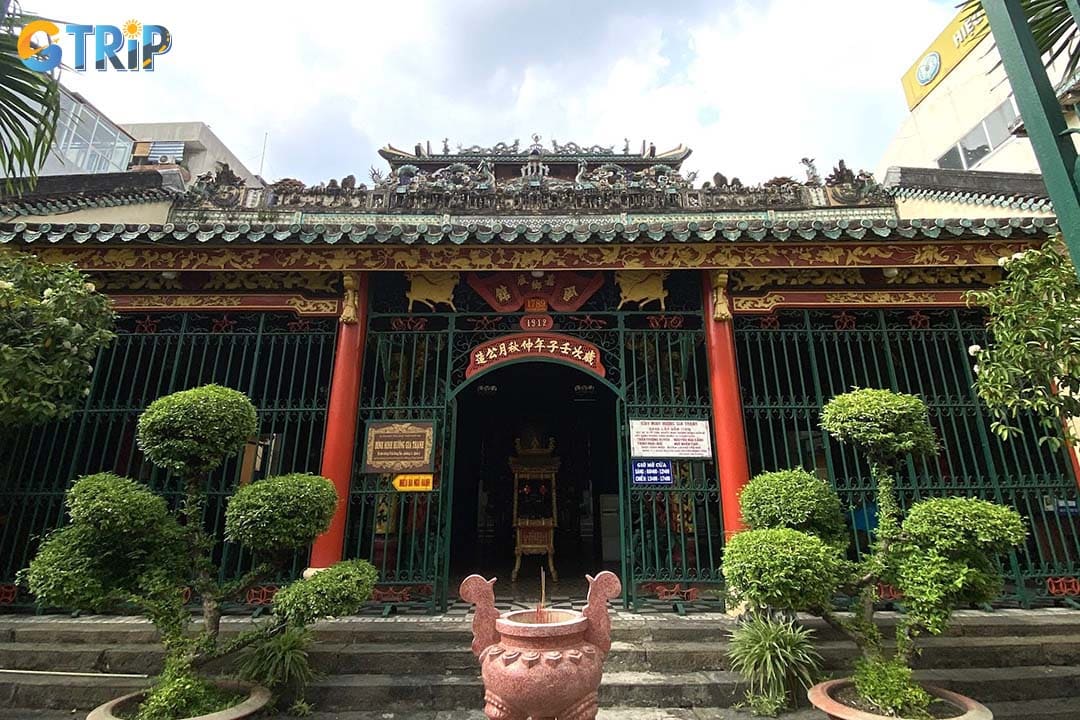
The exterior stands out with brick walls and a roof covered in tube tiles, while the roof edges are clad in glazed lapis lazuli tiles
Front hall (Vo ca)
The vo ca exudes a rustic beauty with precious wooden pillars measuring 60cm in diameter and nearly 7m in height, placed on sturdy white stone bases. Without elaborate carvings or gilding, the center of the front hall features a precious wooden screen exquisitely carved with the "carp transforming into a dragon" motif. This space is heavily concentrated with horizontal lacquered boards and parallel sentences made from the early to mid-19th century. Located right on the right side of the vo ca is the space of the Five Elements Shrine.
Main hall
The main hall is spatially separated from the front hall by an elevated floor and a reverse glass painting screen consisting of 4 panels engraved with the Nom script poem Gia me by Trinh Hoai Duc. The current architecture takes the form of reinforced concrete with 2 stories and 8 roofs, featuring glass windows for natural light. The front is decorated with bao lam (wooden valances) featuring openwork carvings painted in crimson and gold, depicting themes like pine-crane, plum-bird, and crab baskets. The highlight is three large shrines bordered with carvings of two dragons fighting for a pearl:
- The middle shrine: Worships the Tutelary God, Gods of Earth, Gods of Agriculture... In front of the shrine is a stone incense burner and stone statues of Trinh Hoai Duc and Ngo Nhan Tinh.
- The left shrine: Worships Superior Gods Nguyen Huu Canh and Tran Thuong Xuyen.
- The right shrine: Worships two Ministers of Minh Huong descent: Trinh Hoai Duc and Ngo Nhan Tinh. Hanging in the left corner of the main hall is a bronze bell cast in 1823 and a set of 18 traditional weapons.
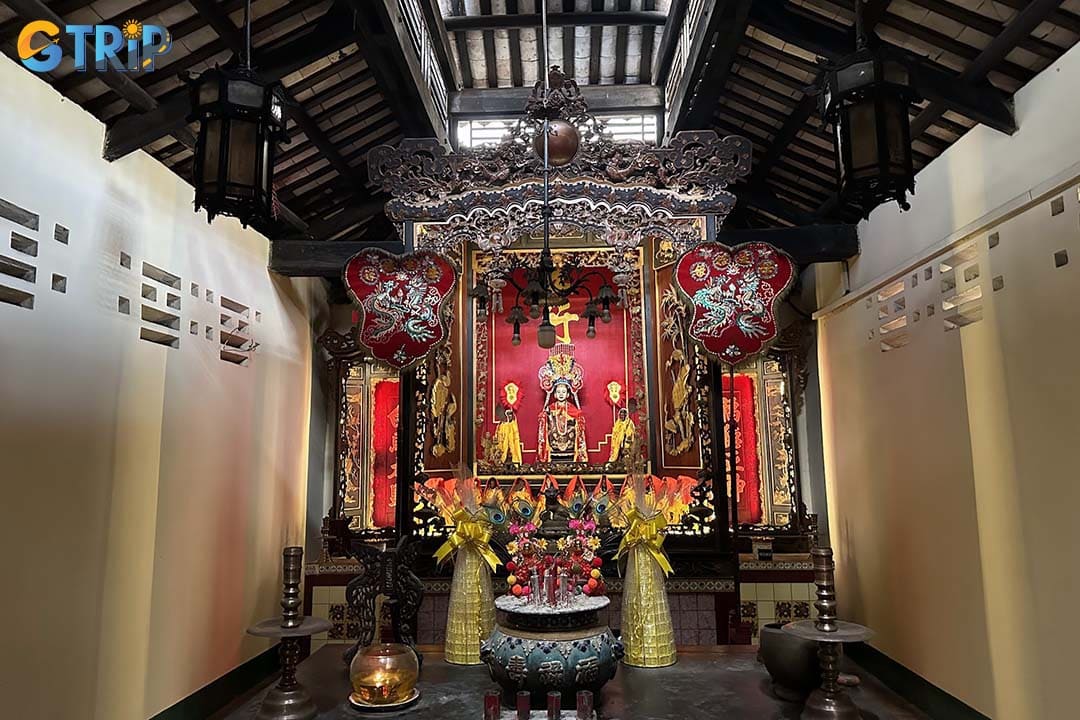
The main hall, where visitors come to pray and worship, contains three large shrines
Back hall
The back hall (truy tu) is separated from the main hall by a small skylight courtyard (thien tinh) crossed by two small bridges, allowing for natural light and ventilation. This place clearly demonstrates the philosophy of "when drinking water, remember its source" with three shrines:
- The middle shrine: Worships the "Early Founders" - the pioneers who established the village and the Minh Huong association.
- The left shrine: Worships village officials and their wives who contributed to restoring the communal house (such as Mr. and Mrs. Truong Cong Si, who donated land to the village).
- The right shrine: Worships minor officials who rendered meritorious services to the village.
Things to do at Minh Huong Communal House
A visit to Minh Huong Communal House offers much more than just a glimpse into the past. To make the most of your visit to this national heritage site, here are the top experiences and activities you should not miss.
1. Attend the Ky Yen Festival and listen to the ancient bell
If you have the opportunity to visit the communal house on the 16th day of the first lunar month annually, you will be immersed in the Ky Yen Festival. It is the most important festival of the assembly hall. This is the time when crowds of locals and tourists gather to offer incense, pray for blessings and peace, and commemorate the merits of early pioneers and famous generals. Notably, this is the only occasion of the year when you can hear the resonant sound of the rare ancient bronze bell. This bell features a two-headed, four-legged dragon handle. It was gifted by King Minh Mang, and was cast by Minh Huong village in 1823 to mark the event of changing the name from "village" to "communal house".
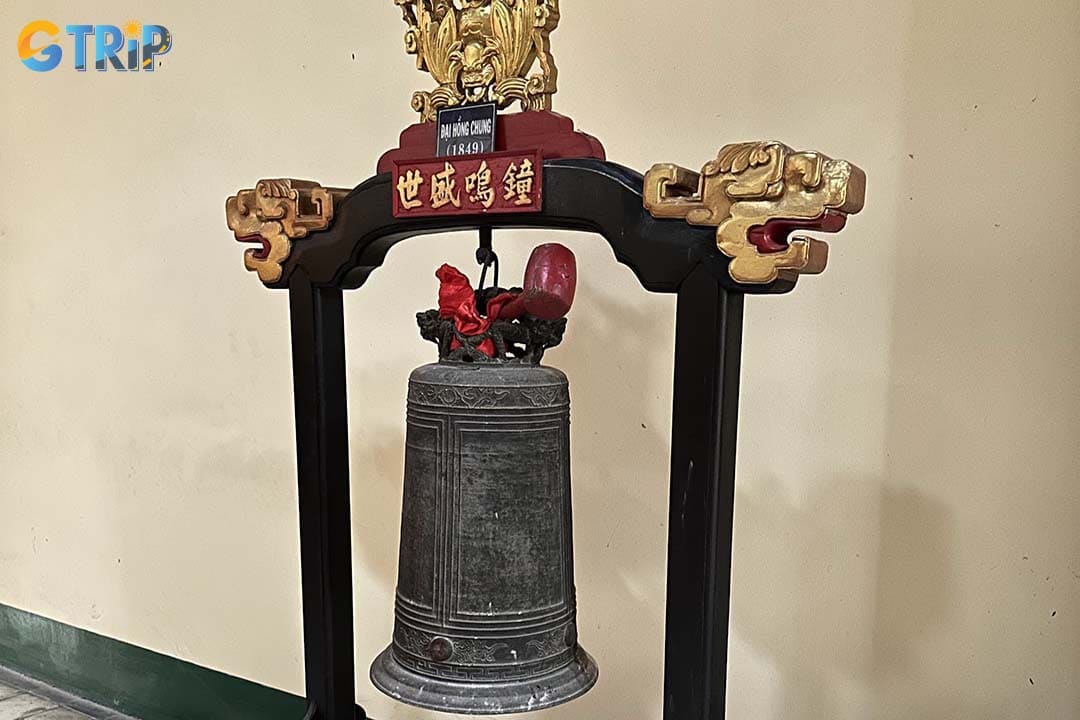
If visiting the Minh Huong Gia Thanh on special occasions, you can hear the resonant sound of the rare ancient bronze bell
2. Admire the Dong Hoa ceramic arts
Right from standing in front of the gate or from the skylight courtyard, take your time to look up at the roof ridge of the communal house to appreciate the exquisite ceramic art. Ancient artisans created a vivid complex of colored ceramic reliefs featuring themes of "two dragons fighting for a pearl", "carp transforming into a dragon", and excerpts from classical plays. These are rare surviving masterpieces crafted by the Dong Hoa pottery kiln itself (belonging to the famous Cay Mai ceramic line of ancient Saigon - Cho Lon) in 1901.
3. Explore the calligraphy heritage and royal antique collection
Minh Huong Communal House is a miniature museum preserving the values of 19th-century sculpture and calligraphy art. You can admire a system comprising 38 horizontal lacquered boards and 22 pairs of parallel sentences. The most outstanding item is a lacquered board carved with four characters: “Thien tuc kha phong” (Good customs worthy of praise). It also bears the words “sac tu” (royally bestowed), granted by King Tu Duc in 1863-1864. Another highlight is a pair of parallel sentences carved along the pillars. They are decorated with embossed images of dragons, unicorns, turtles, and phoenixes. The dragon’s head even protrudes nearly 10 cm above the surface, showing remarkable craftsmanship. In addition, the communal house preserves two stone steles erected in 1839 and 1901, two Dali marble statues (from Yunnan), white stone pillar bases from the Marble Mountains (Da Nang). There are also two cast-iron censers cast in 1842, and a beautifully carved dragon and phoenix furniture set.
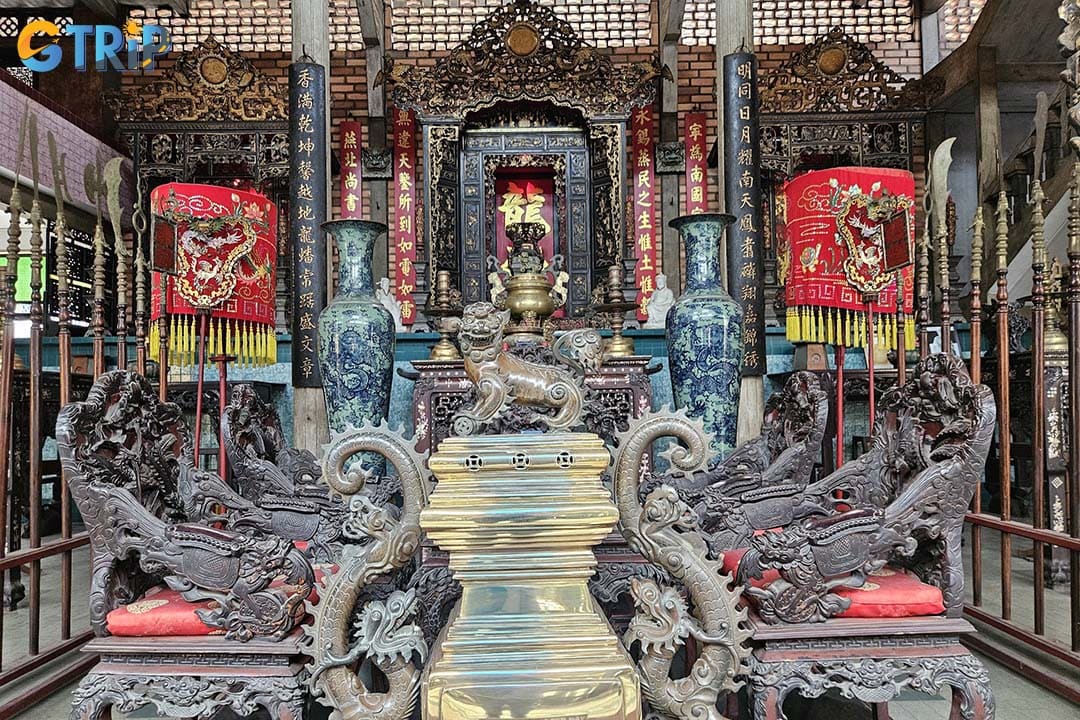
Minh Huong Communal House is a miniature museum preserving the values of 19th-century sculpture and calligraphy art
4. Worship and pray for peace at the Five Elements Shrine
Located on the right side of the vo ca area, the Five Elements Shrine (Mieu Ngu Hanh) is a unique religious space imbued with folk beliefs. Here, visitors can offer incense to worship the Goddesses of the Five Elements and the Goddess of Childbirth (Ba Me Sanh - the deity who specializes in assisting with childbirth). The shrine space impresses with its rich system of worship statues, including the statue of the Goddess of Childbirth, two statues of attendants, and statues of twelve midwives holding babies in their arms. The shrine is also a place to worship the Earth God (Phuc duc chinh than), the White Horse Eunuch (Bach Ma Thai giam), and houses an ancient bronze bell cast in the 2nd year of Tu Duc's reign (1849).
How to get to Minh Huong Communal House?
Reaching the Minh Huong Gia Thanh Communal House is straightforward from any major point in Ho Chi Minh City. Here are detailed instructions from key locations.
From Tan Son Nhat International Airport (SGN)
The journey from the airport to the heart of Cho Lon is a direct route through the city, offering a glimpse of different areas along the way.
- Distance: Approx. 10 km (6.2 miles)
- Travel time: 30-45 minutes, depending on traffic
- Routes: A common route is via Nguyen Van Troi, which becomes Nam Ky Khoi Nghia, then turn onto Vo Van Kiet Boulevard before heading into former District 5.
- Optimal option: Taking a taxi or a ride-sharing service for the most direct and hassle-free journey, especially with luggage.
From Ho Chi Minh City center (e.g., former District 1)
The trip from the city center is short and easy, making it a perfect half-day excursion when combined with other attractions in Cho Lon.
- Distance: Approx. 5 km (3.1 miles)
- Travel time: 15-25 minutes
- Routes: Following the Vo Van Kiet Boulevard along the canal is often the fastest way to bypass city traffic before turning into Cho Lon Ward.
- Optimal option: A ride-sharing app is the most cost-effective and efficient method.
Transportation options
You have several convenient choices for getting around Ho Chi Minh City to reach the communal house.
- Taxi/Ride-sharing apps (Grab, XanhSM): This is the most popular, reliable, and comfortable option. You can choose between a car or a motorbike, and the price is fixed upfront, eliminating any need for haggling.
- Motorbike: For adventurous travelers, renting a motorbike gives you the ultimate freedom to explore at your own pace. However, be aware that traffic in the city is intense and can be challenging for inexperienced riders.
- Public bus: This is the most budget-friendly option. Several bus routes pass along Tran Hung Dao Street. Look for buses heading towards "Cho Lon". It’s a great way to experience the city like a local, but can be crowded and slow during peak hours.
-1777966376d5rLF.jpg)
Getting to Minh Huong Gia Thanh Communal House is straightforward from any major point in Ho Chi Minh City
Nearby attractions to the Minh Huong Communal House
Your visit to the Minh Huong Communal House places you in the heart of Cho Lon, a area brimming with cultural and historical sites. Here are a few must-see attractions you can easily walk or take a short ride to:
- Binh Tay Market: This is the central market of Chinatown, housed in a beautiful building with a distinctive clock tower. It’s a bustling hub of wholesale trade where you can find everything from textiles and housewares to a fantastic array of Vietnamese and Chinese street food.
- Thien Hau Pagoda (Chua Ba Thien Hau): One of the most famous and visually stunning temples in the city, this pagoda is dedicated to Thien Hau, the Lady of the Sea. It's renowned for its incredible dioramas made of porcelain that decorate the temple's roof and walls, depicting scenes from Chinese life and mythology.
- Quan Am Pagoda (Chua Quan Am): Another architectural jewel in Cho Lon, this Fujian-style pagoda is dedicated to Guan Yin, the Goddess of Mercy. It’s known for its ornate decorations, serene atmosphere, and the feeling of stepping back in time as soon as you enter its gates.
- Cha Tam Church (St. Francis Xavier Parish Church): Offering a fascinating cultural contrast, this Catholic church was built in the early 20th century to serve the Chinese Catholic community. Its Gothic architecture with Chinese-influenced decorative elements makes it a unique and historically significant site in the area.
-1777964837rwDdY.jpg)
If you want to feel the local vibe, you can come to Binh Tay Market for shopping
Practical tips for visitors
To ensure your visit is respectful and enjoyable, please keep these simple guidelines in mind.
- Dress code: This is an active place of worship. Dress modestly by covering your shoulders and knees. Avoid wearing shorts, tank tops, or revealing clothing.
- Photography etiquette: Photography of the stunning architecture is welcome. However, be respectful of the space and the people in it. Do not use a flash, and avoid taking intrusive photos of individuals while they are praying.
- Be mindful of worshippers: Speak in a low voice and move quietly through the complex. Remember that this is a sacred space for the local community, not just a tourist attraction.
- Best time to visit: For a peaceful and contemplative experience, a weekday morning is ideal. The light is beautiful for photography, and the crowds are minimal.
- Stay hydrated: Ho Chi Minh City can be hot and humid. Carry a bottle of water with you as you explore the area.
Read more:
The Minh Huong Gia Thanh Communal House is more than just an old building. It is a portal to the past and a cultural sanctuary that tells a powerful story of identity and resilience. It embodies the rich, multicultural tapestry that makes Ho Chi Minh City so dynamic. A visit here offers a rare glimpse into the soul of the Minh Huong people and a deeper understanding of the forces that shaped modern Saigon. For more curated travel guides, insider tips, and authentic Ho Chi Minh City tours for your Vietnam adventure, trust GTrip to lead the way.
Custom Your Journey

Other Attractions
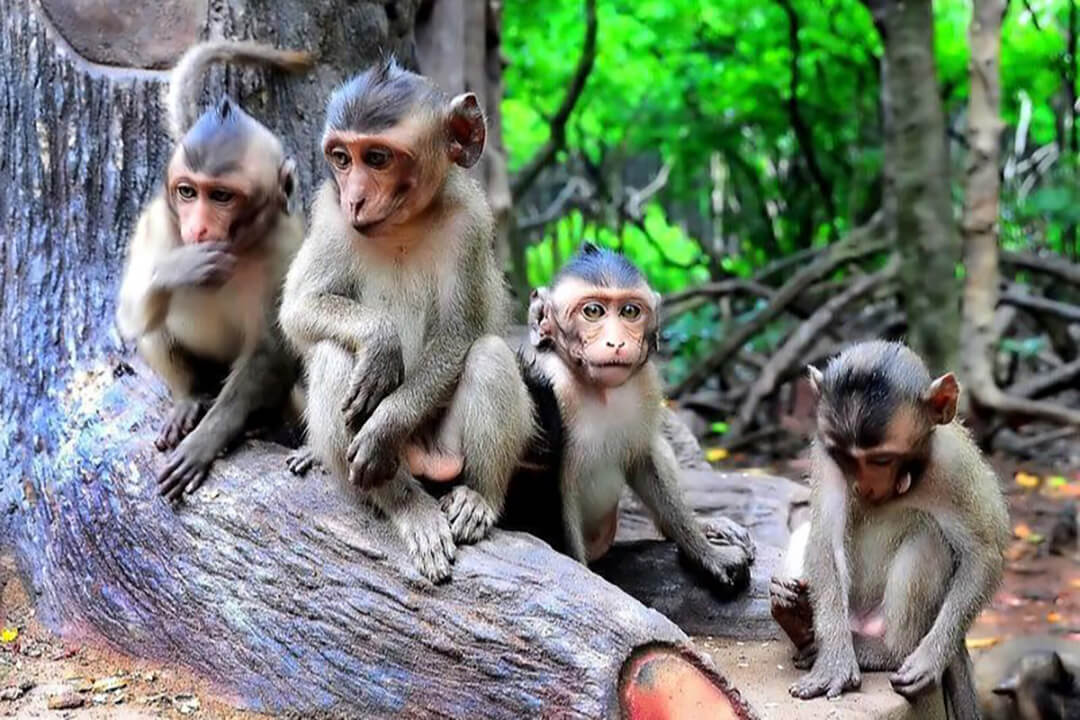
Can Gio Monkey Island in Ho Chi Minh City: Tickets, Things to Do & Travel Guide
Can Gio Monkey Island
Can Gio Monkey Island in Ho Chi Minh City offers a refreshing escape from the city’s buzzing motorbike chaos. Just a short distance from the center, Can Gio welcomes you with lush mangrove forests, winding waterways, and a fascinating history. Here, you can meet playful long-tailed macaques, drift through tranquil channels, and explore remnants of a wartime guerrilla base.
Can Gio Monkey Island in Ho Chi Minh City: Tickets, Things to Do & Travel Guide
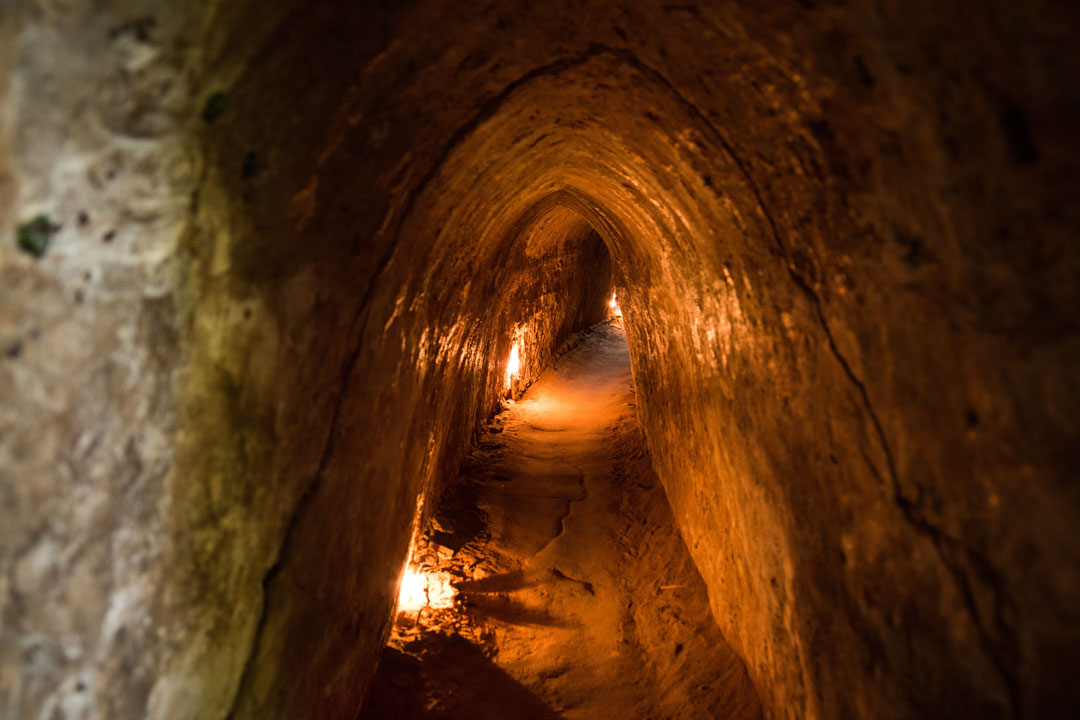
Cu Chi Tunnels: History, Architecture, Things To Do & Travel Guide
Cu Chi Tunnels
The Cu Chi Tunnels, located at TL15, Phu Hiep, Cu Chi District, Ho Chi Minh City, are a vast underground network of strategic passages, shelters, supply routes, and defensive traps.
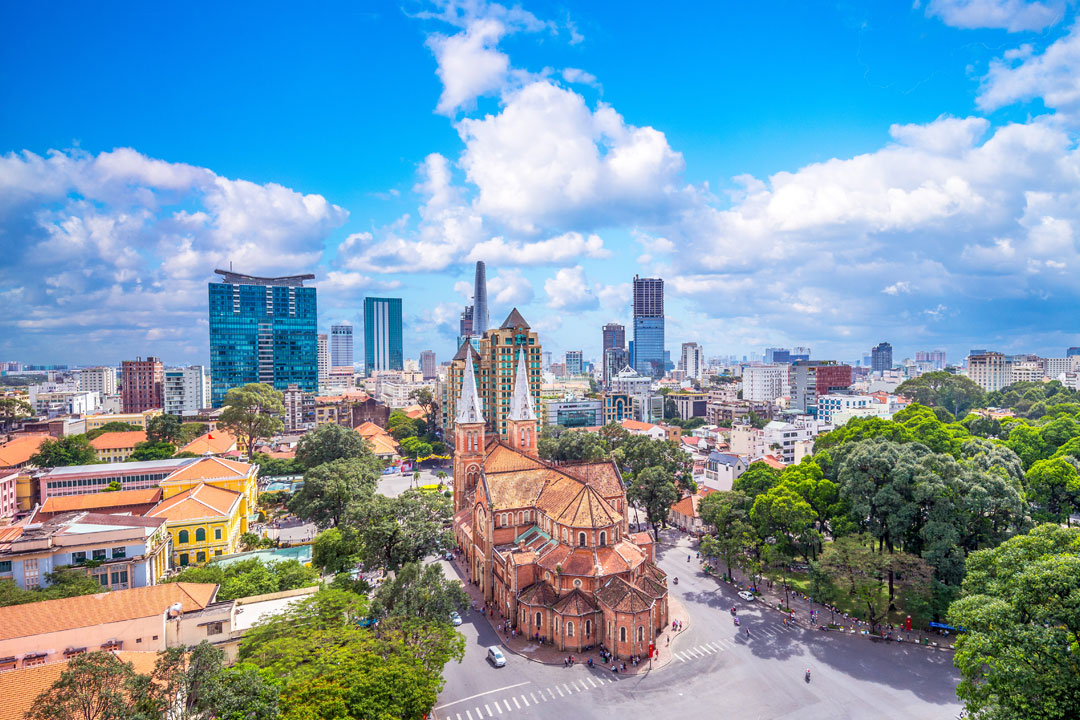
Ho Chi Minh City
Ho Chi Minh City, known as the "Pearl of the Far East," attracts both domestic and foreign tourists with its unique and diverse destinations.
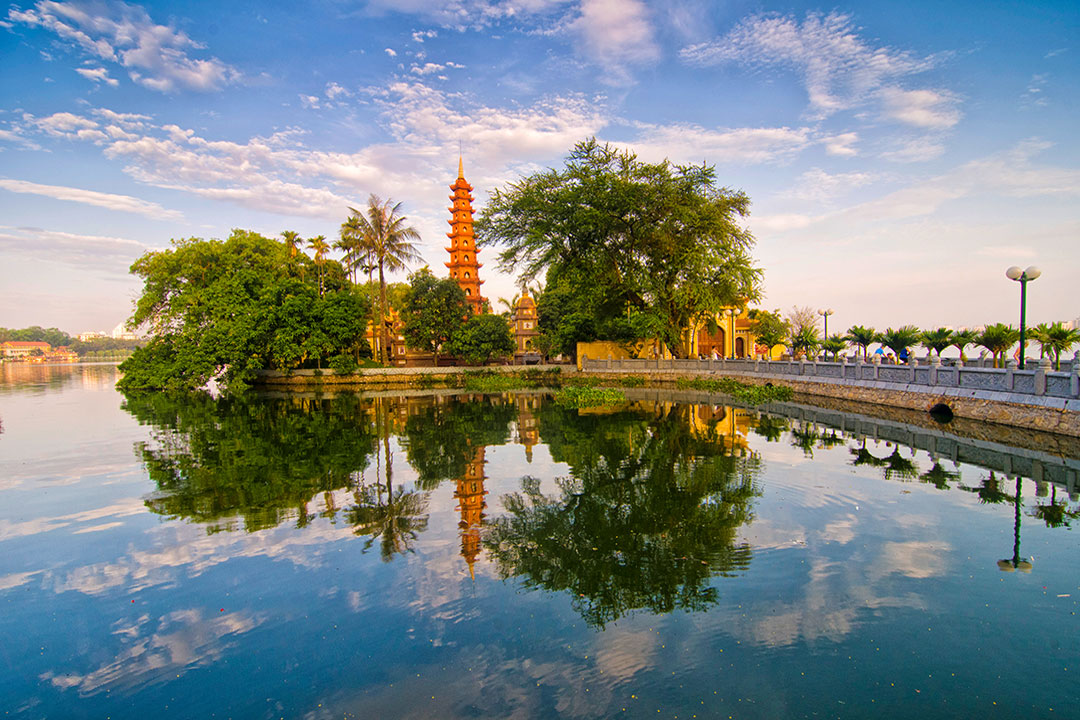
Tran Quoc Pagoda: History, Architecture, Significance & Travel Guide
Tran Quoc Pagoda
Nestled on the tranquil shores of West Lake, Tran Quoc Pagoda is the oldest Buddhist temple in Hanoi, with a history spanning over 1,500 years. Built in the 6th century under Emperor Ly Nam De, this sacred site reflects Vietnam’s Buddhist evolution while preserving its spiritual and architectural grandeur.